EXPO 2025
Czech National Pavilion for EXPO 2025 in Ósaka
1st Prize in Open Architectural Competition, Built
Ósaka, Japan, 2025
Ing. arch. Michal Gabaš
Ing. arch. Tomáš Beránek
Ing. arch. Nikoleta Slováková
Ing. arch. Tereza Šváchová
Collaboration:
Eva Gabaš Rosenová
Kryštof Jireš
Jana Watersová
Laura Lukáčová
Miroslav Slezák
Natálie Poláková
Alexandra Mishchenko
Magdalen Havlová
Visual communication: Lunchmeat Studio
Jakub Pešek
Jan Kistanov
Jiří Kubalík
Exhibition concept:
Lucie Drdová
Rony Plesl
Jakub Matuška aka Maskér
Lunchmeat Studio
Fotography: BOYS PLAY NICE
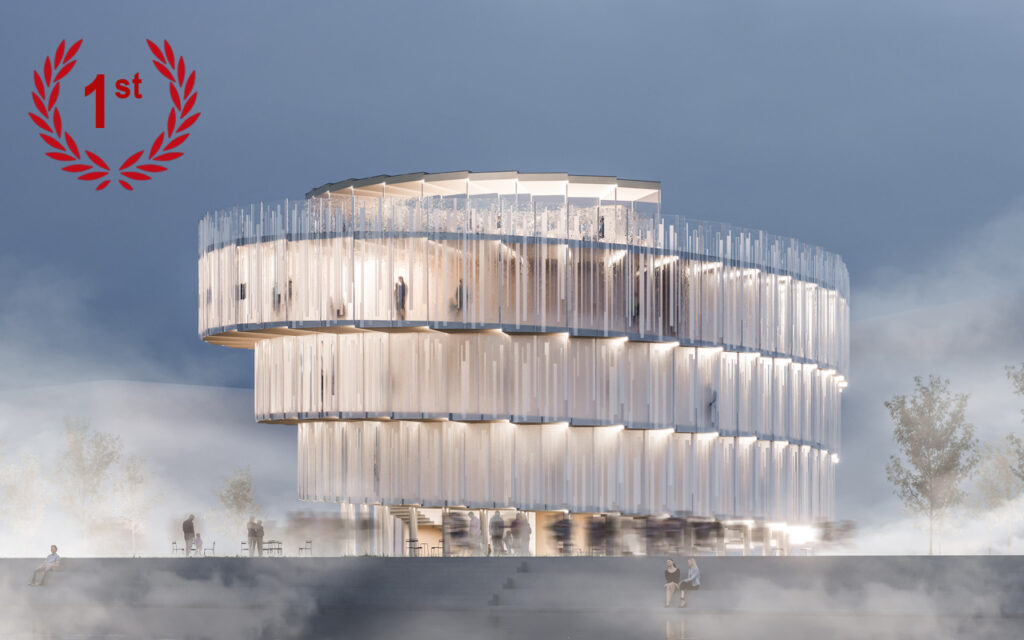
The design concept of the Czech National Pavilion for the World Expo in Osaka is based on the spiral — the visitor’s path that winds around the building upwards, gradually expanding and symbolizing the journey of society and the shaping of its vitality. The dynamic, upward-spiraling movement can also represent the ideal life path, encompassing both personal and social development, as well as the trajectory of education.
The pavilion encourages visitors to move upward, requiring physical effort, while the exhibition content invites intellectual engagement and reflection on cultural and spiritual values. By actively moving through the pavilion and absorbing the cultural content of the exhibition, visitors experience a strengthening and shaping of their inner vitality. The architectural concept manifests as a dynamically formed mass that appears outwardly light, transparent, and airy, seemingly defying gravity. A closer study, however, reveals a clear and precise geometric structural logic expressed throughout the building.
The pavilion takes advantage of its prominent location on the edge of the waterfront promenade. In any weather, it draws attention with its dominant, solitary form and the visual impact of the glass-transparent building envelope. This envelope recalls the rich history of glassmaking in the Czech lands while providing unconventional exhibition spaces with a changing internal atmosphere.
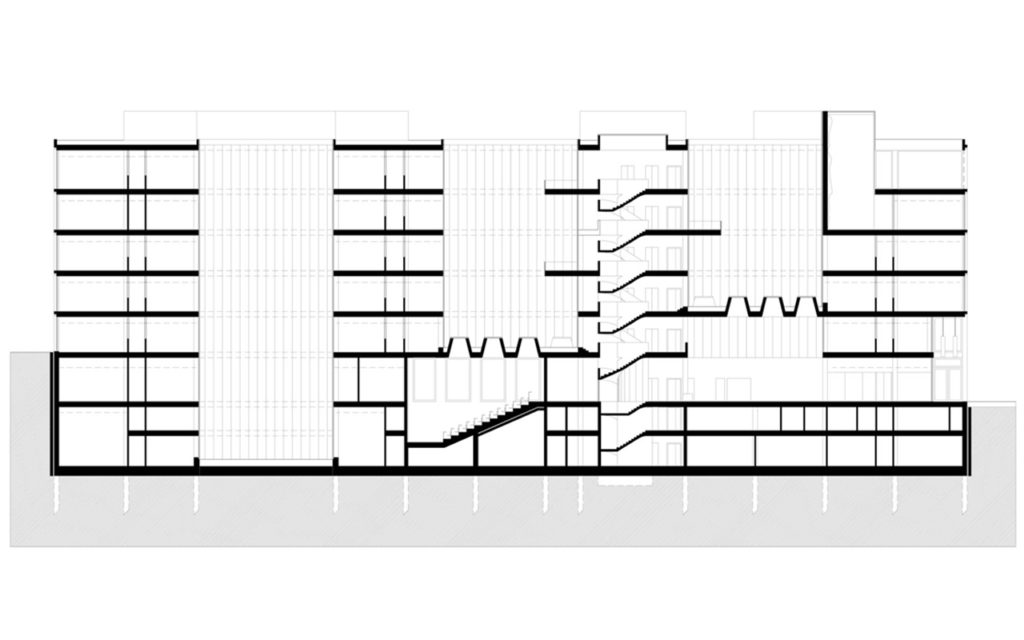
The pavilion’s silhouette is iconic. The spiral — a symbol of upward progression — responds to the internal layout of the building. A barrier-free spiral ramp of exhibition spaces wraps around the central multifunctional hall – the auditorium. With an internal diameter of 15.5 meters, the auditorium rises to 12 meters above ground level. Together with it, the exhibition spiral ascends, with its movement mirrored by the visitor ramp that forms seating terraces inside the auditorium. The seating is, in several locations, also connected to the exhibition path, allowing the two functions to be either separated or integrated as needed.
The spiral, wrapping logically around the central auditorium, serves as both an exhibition and circulation ramp, providing a smooth, linear upward movement for visitors. The total path measures 260 meters, with its width expanding from purely passable 1.8 meters at the entrance and exit to wider exhibition spaces. The niches of the internal auditorium cylinder are also utilized for exhibition purposes. At 12 meters height, the ramp opens onto a spacious viewing terrace with a rooftop “crown,” which houses the VIP Lounge. Visitors experience not only views over the calm sea but also sightlines through the glass skylight down into the auditorium.
A staircase embedded within the hollow double walls of the cylinder provides the downward path, leading to the ground floor, which houses the restaurant and serves as the final chapter of the exhibition. Parallel to the visitor staircase, a second stair is wound within the internal cylinder for auditorium functions, connecting the restaurant on the ground floor, the auditorium and its seating terraces, and the VIP Lounge on the top floor. This dual staircase system allows the exhibition and multifunctional hall operations to be fully separated if needed. Barrier-free access is ensured via an elevator situated in the western section of the central cylinder.
The structural system is composed of cross-laminated timber (CLT) panels, forming the central auditorium core with integrated staircases and elevator. The core is complemented by horizontally laid panels that shape the exhibition spiral outward and the auditorium balconies inward. The building’s footprint is divided into 36 segments, regularly subdividing the circle on the lower floors and defining an ellipse in the upper floors, shaping the pavilion’s envelope and mass.
In line with the overall site concept, the pavilion’s primary energy source is electricity. Its geometry actively contributes to shading both internal and external spaces. The building is equipped with a central air-handling unit, located in the technical area of the basement, connected to a central cooling source.